Thursday, September 23, 2010

Growing Cowpea Beans in Pit Method Summer Cultivation

Growing Cowpea Beans in Pit Method Summer Cultivation by Pritham 'Metal Farmer' D'Souza

From Growing Cowpea Lentils using Pit Method at Padval Farms, India


Cowpea (Vigna unguiculata) is a very popular vegetable grown in Mangalore and other parts of th country. It has been grown in India since the Vedic period. The entire plant is of economic importance, the pods harvested are rich in proteins, while the foliage is used as green manure and fodder for animals. Its called Alasandae in kannada, alasundae sango in konkani and Lattanae in Tulu

CLIMATE AND SOIL

From Growing Cowpea Lentils using Pit Method at Padval Farms, India


From Growing Cowpea Lentils using Pit Method at Padval Farms, India


  • requires well drained soils
  • saline or alkaline soils should be avoided
  • it can tolerate drought to a certain extent but cannot withstand water logging
  • partial shade is tolerated however its highly succeptable to frost
  • being a tropical crop it thrives at temps between 21 to 35 degrees centigrade
LAND PREPARATION

since this crop is grown on a hilly area, we chose to grow it in pits and not the traditional method of growing them in rows.
  • square pits the size of 90cmx90cm with depth of 30 cm are made as shown
  • the distance between the pits is maintained
  • each pit, 2 buckets of decomposed farm yard manure is added and the soil is well mixed
  • around 5 seeds are sowed in each pit and after germination 4 are retained in each pit
Since this variety grows long, it requires vertical support and hence the distance between the pits is very important to prevent over crowding.

From Growing Cowpea Lentils using Pit Method at Padval Farms, India


MANURING AND IRRIGATION
  • being a root nodule crop, heavy nitrogen fertilizer application is not required, however timely application of nutrients allows for better yield results
  • since we apply only decomposed farm yard manure with bacterial culture for faster decomposition, we split the manure application into 3 doses. first dose at the time of land preparation and sowing. second dose, when the plant has attained a height of 45 cms and the third and final dose on the on set of flower buds.
  • since this is a summer method of cultivation, irrigation is very important and must be done at regular intervals to avoid wilting due to extreme temperatures.
  • light irrigation at germination stage followed by irrigation during the early hours of the day is best for the crop during later growth
  • not much mulching is required as the root zone will get adequate shade from the plant
From Growing Cowpea Lentils using Pit Method at Padval Farms, India


From Growing Cowpea Lentils using Pit Method at Padval Farms, India


From Growing Cowpea Lentils using Pit Method at Padval Farms, India


From Growing Cowpea Lentils using Pit Method at Padval Farms, India


OTHER AGRI OPERATIONS
  • weeds are a serious pest and need to be dealt with immediately
  • during the second and third manure applications, the soil surrounding the roots are made loose and manure mixed properly. this increases soil aeration
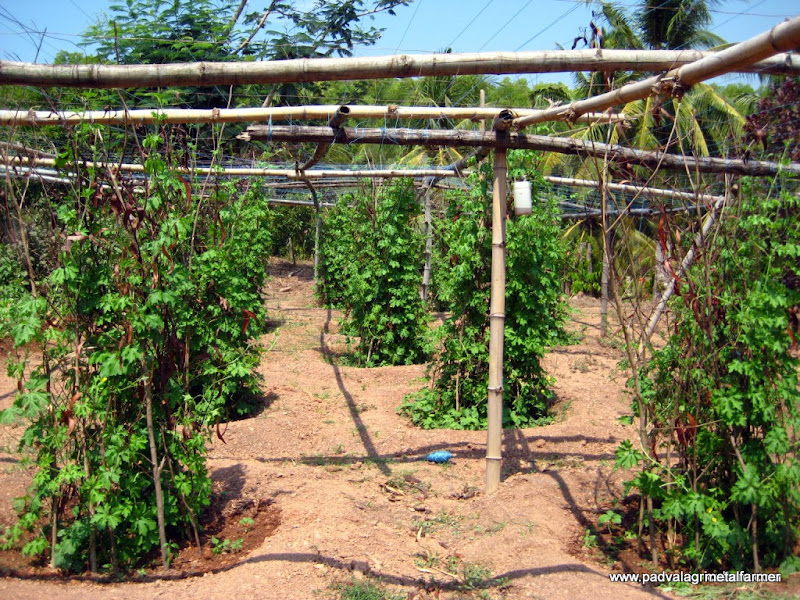
  • when the plant start to develpo long tendrils, vertical support needs to be given as shown
  • the plants are then trained to grow on the support
From Growing Cowpea Lentils using Pit Method at Padval Farms, India


FLOWERING AND HARVEST
  • most varieties start to produce flower buds after 45 days after sowing, and pods can be harvested after 15 days after pod setting
  • the fruits formed can be harvested up to 45 to 60 days after flowering and then there will be gradual decrease in yield and also quality.
  • spraying with plant hormones before the onset of flowering, produces more female flowers and is recommended
  • growing flower crops like marigold side by side also increases the yield due to increase in pollinating agents like bees, wasps etc
From Growing Cowpea Lentils using Pit Method at Padval Farms, India


From Growing Cowpea Lentils using Pit Method at Padval Farms, India


From Growing Cowpea Lentils using Pit Method at Padval Farms, India


From Growing Cowpea Lentils using Pit Method at Padval Farms, India


PEST AND DISEASE MANAGEMENT
Pod borer (Muruca tesulatis and Lampides boeticus) is the single most destructive pest, resulting in over 80 percent crop loss. colonies of aphids are also seen on young leaves and inflorescence and makes harvesting difficult. Leaf eating caterpillars tend to skeletonise the plants if not checked properly
  • for pod borer, chemical application is foliar spray with a combination of profenophos and cypermethrin @2 ml per litre of water sprayed at interval of 10 days just at the onset of flower bud formation.
  • we use pure neem oil @10 ml per litre of water and sprayed at 7 day intervals
the application of neem is not a 100 percent guarantee to eliminate pod borer problem, but it controls the problem to a great extent and is an organic method of controlling
  • for leaf eating caterpillars, hand picking using gloves and destroying the pests is the best option even though its cumbersome.
  • aphid problem can be controlled by using the least toxic imidochloprid @half ml per litre of water at 14 day intervals. other chemical method is using Dimethoate Rogar at 1 ml per litre of water and sprayed when the incidence is observed.
From Growing Cowpea Lentils using Pit Method at Padval Farms, India


SOME IMPORTANT TIPS
  • bugs that emit characteristic odor are not a serious pest and can be controlled using neem sprays
  • Bruchid (Callosobruchus chinensis) causes damage to stored cowpea seeds by the grubs which turn the seed hollow by eating from inside. infestation starts in the field but can be seen mostly at storage. adding 2 percent edible oil (volume by weight) controls this problem for at least 5 months. seeds have to be dried thoroughly before storage.
  • foliar application of neem should be done in the evenings when the intensity of sunlight is less. after 4 pm before 6 pm is ideal
  • the tender succulent pods are preferred to over ripe wrinkled pods. and so harvesting every day is recommended to avoid this problem
all images and data by Pritham 'Metal Farmer' D'Souza

Flight T bait trap Container

Flight T bait trap Container by Pritham D'Souza Metal Farmer

From Flight T bait trap by PCI


The flight T bait trap container introduced by PCI is a strong and durable container
I have already used this successfully in controlling Daucus dorsalis pest attacking my cucurbit crops.
From Flight T bait trap by PCI


  • what you see here is a large number of dorsalis flies that were caught in 2 days
From Flight T bait trap by PCI


From Flight T bait trap by PCI

  • the trapped dead flies are discarded and collecting vessel washed thoroughly
  • detergent water is added along with water in the collecting tray
From Flight T bait trap by PCI

  • the bait is then placed in the container and the top closed using the cover
  • it is then suspended using its hook either under a trellis or close by to the crop
  • as you can see, the bottom is open in the middle which allows the insects to fly into the container.
From Flight T bait trap by PCI

  • once the insect gets intoxicated by the pheromone trap and falls into the collecting tray filled with detergent water, it dies due to drowning
  • hundreds of flies are caught this way and the entire operation is repeated at intervals of 7 to 10 days, denending on the pest incedence.
  • detergent water is preferred over normal water, as normal water can breed mosquitoes.

if you are interested in purchasing these bait traps you can contact Mr. Ranjan Shagrithaya on his mobile @ 9448485353 and email him at bioranjan@gmail.com

all images and data by Pritham 'metalfarmer' D'Souza

Mosaic Virus Disease in Okra Bhendi Ladies Finger

Mosaic Virus Disease in Okra Bhendi Ladies Finger by Pritham D'Souza 'Metal Farmer'

From Mosaic Virus Disease in Okra Bhendi


Yellow mosaic disease in Okra is one of the most devastating diseases, resulting in 80 percent of crop loss.
and the sad part is , since its a virus, there is no cure. Prevention is the only cure.

From Mosaic Virus Disease in Okra Bhendi


Symptoms and Damage
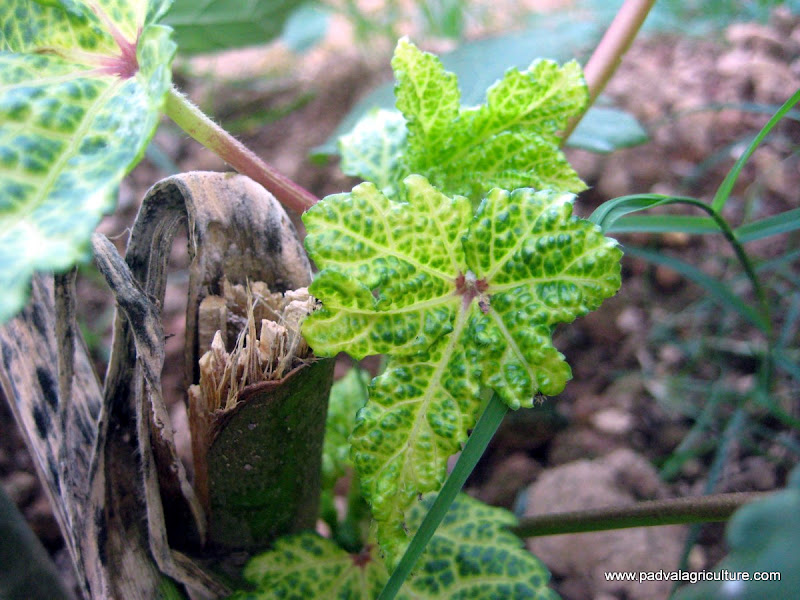
  • intricate network of interwoven yellow veins, enclosing islands of green tissue within
  • the appearance looks similar to that of a mosaic floor tile and hence the name
  • causes up to 80 to 90 percent loss
  • transmitted by vectors like plant hoppers and other sucking pests of okra
From Mosaic Virus Disease in Okra Bhendi


From Mosaic Virus Disease in Okra Bhendi


From Mosaic Virus Disease in Okra Bhendi


Management
  • Since it is a virus there is no cure, however Prevention is the only cure
  • the vectors that are responsible for the spread of the virus need to be controlled
  • Chemical methods include using dimethoate (rogar) 1 ml per litre of water as a foliar application at 10 day intervals
  • Organic methods include 5 to 10 ml neem oil in 1 litre of water, foliar spray at weekly intervals
  • the spraying must be done preferably during late hours, when temp is cooler (after 4pm till 6 pm)
  • when an infected plant is seen, it must be uprooted and destroyed immeadiately
  • plant residue including leaves etc must be cleared from main site or it the infection can spread to other healthy plants
  • resistant hybrids like 'arka annamika', 'arka abhay' must be used
all images and data by Pritham 'metal farmer' D'Souza

Pitting method of Cultivating Bitter Gourd

Pitting method of Cultivating Bitter Gourd by Pritham Denzil Dsouza aka 'Metal Farmer'
i have already discussed how to cultivate Bitter Gourd (Momordica charantia) in my previous post in continuous pits . here i would like to show you how one can grow Bitter Gourds in individual pits.


  • the size of every pit is around 60 cms X 60 cms and height is about 30 cms
  • in every pit around 6 seeds are sowed
  • after germination, 3 seeds are retained per pit
  • this is done to prevent over crowding

  • support in the form of sticks has to be given during vegetative phase
  • the vines tend to fall to the ground and care has to be taken to see the vines are trained on top of the support so as to move upwards

  • during flowering phase, thousands of bright yellow flowers are seen, however only one tenth of them will pollinate and yield fruit


  • once the vines reach a desired height as shown above, they will need to start growing vertically and a proper trellis needs to be built as seen in the pic below


  • results can be seen in 21 days as the pic shows above
  • retaining just 3 seeds per pit has resulted in lush growth of the vines in every pit
  • watering the pits is easy and there is no wastage
  • application of manures can also easily be done per pit


  • there is a tendency for the vines to produce excessive lateral shoots and they too are given support so they move upwards as shown in the pic above


Advantages of growing in pits
  • plant density and plant population can be maintained
  • no over crowding
  • application of manure and fertilizer is much easy
  • no wastage due to excessive drainage
  • spraying with neem using back pack sprayer is convenient and can be done from a distance
  • harvesting is easy
  • the resultant shade increases pollination by attracting a large number of pollinators
all images and data by Pritham 'Metal Farmer' D'Souza

Friday, August 13, 2010

The Electric Tears featured on Mix Tape India Vol 2

The Electric Tears featured on Mix Tape India Vol 2
The Electric Tears, an Electric acoustic side project of Pritham Dsouza aka Metalfarmer is featured in Mix Tape India vol 2 with other acts viz Ashu, dhruv, skinny alley and more...

Release Notes:

This compilation is catagorised under ' Easy Listening ' (Pop,Blues,World,Jazz Rock)

Track List :

1. Smoke - You're So Beautiful (2008)Blue Frog Records
2. Saransh Agarwal - Forever (2009)Self Release
3. Avi - Who? (2010)Self Release
4. Odyssey - Ventilator (2010)Self Release
5. Skinny Alley - Escape The Roar (2003)Self Release
6. Ashu - Europa (2008)Blue Frog Records
7. Dhruv - Only If (2009)Blue Frog Records
8. Shaa'ir Func - New Day (2008)Blue Frog Records
9. Esperanto feat. Martin Kinz - Jo Jo Jo Jo (2003)Kreek Records
10. Vivek Rajagopalan - If I Were To Leave You (2008)Blue Frog Records
11. Sanjay Divecha - Full Circle (2008)Blue Frog Records
12. The Electric Tears - Hope and Redemption (2009)Self Release

Credits

Thanks to all the artists for allowing this to happen.

Ashu (Mumbai) - www.ashulive.com
Avi (Gurgaon) - www.myspace.com/avisingersongwriter
Dhruv (Mumbai) - www.myspace.com/dhruvlive
Esperanto (Bangalore) - www.myspace.com/esperantosoulfusion
Odyssey (Surat) - www.reverbnation.com/odysseyindia
Sanjay Divecha (Mumbai) - www.myspace.com/sanjaydivecha
Saransh Agarwal (Bangalore) - www.reverbnation.com/saranshagarwal
Shaa'ir + Func (Mumbai) - www.shaairandfunc.com
Skinny Alley (Kolkata) - www.skinnyalley.com
Smoke (Mumbai) - www.myspace.com/smokealbum
The Electric Tears (Mangalore) - www.gimmesound.com/theelectrictears
Vivek Rajagopalan (Mumbai) - www.vivekrajagopalan.com

Cover Photo: Suyog Gaidhani - www.flickr.com/photos/suyog/

Graphic Artist : Siddhartha Mukherjee - siddhartha19.deviantart.com


Thanks to Dharmendra Chakrasali for his wonderful initiative.... visit www.indicore.com for more compilations!!

Bed Pan Boy covers Acrid semblance Track "mindgames"

Bed Pan Boy covers Acrid semblance Track "mindgames" and re names it "Acrid Mind, No Semblance At All"

listen to the track here


Bitter Gourd Cultivation in Continuous Pits

Bitter Gourd Cultivation in Continuous Pits by Pritham D'Souza Metal Farmer

Bitter Gourd (Momordica charantia) also known as bitter gourd or Karela (hindi), karathe (konkani) and kanchala (tulu) is cultivated in mainly tropical and sub tropical places throughout the world.
From Bitter gourd cultivation in continuous pits By Pritham D'Souza Metal Farmer


The bitter taste is due to the presence of Momorcidin. The wonder fruit, which is consumed as a vegetable is widely used in traditional medicines and is well known for treatment against diabetes, preventing malaria and constipation. It is also used as an effective bio repellent. however the red arils of the seed (outer red coating) can be toxic to children.

Bitter gourd is an acquired taste, but its medicinal properties make it a commercially viable crop.

Climate and Soil
From Bitter gourd cultivation in continuous pits By Pritham D'Souza Metal Farmer

  • being a tropical crop, it grows well in temperatures ranging from 28 to 35 degrees celcius
  • extreme temperatures not favorable as it will result in spread of mosaic disease caused by virus
  • soils have to be well drained and loamy.
Sowing
From Bitter gourd cultivation in continuous pits By Pritham D'Souza Metal Farmer

  • the seed coat is very hard and unless conditions are favorable, germination will not take place as usual. for this , soaking the seeds in water for a minimum of 24 hours before sowing is recommended to break the seed dormancy
  • in some places water is replaced by curds and it also helps in rapid germination as the curds contain bacteria which also break the seed dormancy by softening the hard seed coat
From Bitter gourd cultivation in continuous pits By Pritham D'Souza Metal Farmer


  • dried and decomposed farm yard manure is added to the pits just before sowing the seeds
  • each pit, about 5 seeds are sowed and after germination 2 plants retained in every pit
  • the distance between pits is about 45 cms
Inter Culture Operations
From Bitter gourd cultivation in continuous pits By Pritham D'Souza Metal Farmer

  • after about 21 days after sowing, the growing tendrils will begin to droop on the ground. this will require support and it being a climber, adequate arrangements need to be made
From Bitter gourd cultivation in continuous pits By Pritham D'Souza Metal Farmer

  • here the soil around each plant is gathered around to fortify the pit and organic manure is added to each pit
  • then support in the form of long sticks is placed in each pit as shown
  • the growing vines are then trained on them and a pendal is erected
From Bitter gourd cultivation in continuous pits By Pritham D'Souza Metal Farmer

From Bitter gourd cultivation in continuous pits By Pritham D'Souza Metal Farmer

  • the pits help to prevent excess leaching of water and acts as a retention barrier
  • weeding, irrigation and earthing up of the soils are made easier
  • moist soils require less irrigation, about once a week, while areas which have direct sunlight, require frequent irrigation.
  • pits also help in mulching and prevents loss of water by evaporation
Flowering and Harvest
From Bitter gourd cultivation in continuous pits By Pritham D'Souza Metal Farmer

  • spraying certain growth hormones such as Ethrel is done to increase the number of felame flowers and has to be done 2 weeks before flowering begins
  • during flowering, another dose of farm yard manure or dried and decomposed organic manure is added @ 10 kg per pit
  • if the manure is fresh and not properly decomposed, it will injur the roots and stem
From Bitter gourd cultivation in continuous pits By Pritham D'Souza Metal Farmer

  • fruits can be harvested after 60 to 75 days from the first day of sowing
  • the tender , immature fruits are preferred over ripe fruits
  • soon after harvesting, they are washed in water and dried before taking to market
Pests of Bitter Gourd and Treatment
  • the bitter taste of the fruit prevents it from getting attacked as frequent as the other crops belonging to the cucurbit family, however the major pests include the following
  1. red pumpkin beetles which are most notorious as if feeds the young and tender leaves during growth stage. also feeds on the flowers .
  2. Stink Bugs are huge and have a plate of scaly armour to prevent from natural predators attacking it. also it releases a stink liquid which helps it to escape before getting caught. it feeds on tender fruits and results on rotting of the fruit
  3. aphids and thrips can cause serious damage, while the former can colonise the plant, the latter can feed on the leaves which later curl inside
  4. leaf eating caterpillar destroy the leaves and skeletonise the plant, the silk cucoons can be seen mostly on lower surface of the leaves
  5. fruit fly bores on the growing fruit and lays the eggs which grow inside the fruit. worms can be seen in the rotting fruits
Treatment
integrated farm management practises recommend the use of both organic as well as chemical pesticides for effective control of pests . however since i advocate the use of mostly neem based sprays, i advise the following
  1. neem cake applied to the soil at 25 day intervals around the plant
  2. during the growing stage, neem solution is sprayed weekly twice @5 ml per litre water
  3. during flowering stage , Neem solution is sprayed weekly once @10 ml per litre
  4. since neem is all natural and non toxic , it can be sprayed on standing crops and when yield is seen
  5. spray neem preferably in the evenings, when its cooler between 4 to 6 pm

all data and images by Pritham dsouza aka Metalfarmer